Physical Address
I-14/4, Islamabad, Pakistan
Table of Contents
ToggleArtificial intelligence (AI) is no longer just an experimental technology in the finance sector; it has become a reliable and beneficial solution for accountants, finance professionals, firms, and even small business owners. The rise of AI accounting software has revolutionized the entire process of handling financial data, from processing and analysis to auditing and reporting. AI systems are now performing tasks that were done manually for hours, and the collaboration between the accountant and AI is now a smooth one, rather than a rivalry.
This comprehensive guide to AI in the accounting sector provides a deep, multifaceted view. It first addresses the most crucial concerns that professionals have about AI in accounting technology, and then it goes on to cover in depth the AI tools that are employed in accounting and finance, their benefits, case scenarios, and the future of the profession.
The accounting field has been increasingly adopting AI technologies such as machine learning, natural language processing, and automation—collectively called AI in accounting—to do the accounting and financial tasks previously done manually. Some of those tasks include inputting data, categorizing transactions, processing invoices, reconciling accounts, predicting, detecting fraud, and analyzing finances.
AI accounting software is in demand in the industry because of its ability to process large amounts of financial data faster and more accurately than a human can. The accounting process is mainly done by people and consists of tasks that are very hard and time-consuming, thus being prone to errors. AI in accounting has overcome these limitations by learning the patterns, detecting the anomalies, and getting better continuously at its job.
AI in accounting has become a necessity for modern enterprises rather than a choice to make. It is turning into a competitive advantage which grants accountants to direct their efforts in the areas of strategy, advice, and decision-making rather than doing non-value-adding tasks.
Applying automatic processes along with the intelligent learning systems is the working of AI accounting software. Accounting AI is not like traditional accounting software, which follows strict rules; it is progressively adapting and getting better over time.
The systems are examining historical financial data, detecting patterns, and putting that knowledge into effect with new transactions. For instance, AI can align the categorization of expenses, invoice payments, and bank statements, playing along with them, and also detecting unusual transactions.
Most of the accounting AI platforms are now able to work together with accounting systems, ERP software, and banking platforms. This provides the facilitation of data flow and instant financial insights. The software becomes accurate and efficient with time as it continues to work on data.
This is the reason why AI and accountants working together make a great team compared to their individual efforts.
The use of AI accounting software has a revolutionary effect on accountants’ daily activities. In the past, the accounting profession was characterized by labor-intensive data entry, reconciliation, and verification of data. Nowadays, AI apps for finance and accounting are helping to speed up and improve the accuracy of the workflow with less human input required. Activities that were previously done by humans are now being performed by machines, with very little input from humans, and thus the machines are now doing the work that once took humans a longer time to do.
The technological change does not reduce the necessity of accountants but alters their working conditions. Accountants and AI working together will lead the professionals to the point where the whole business will be analyzed in terms of compliance, and their services will be mainly advisory. With AI in accounting, the accountants will be able to access the financial data in real-time, spot the trends earlier, and give the clients and businesses the insights that are proactive.
On top of that, AI-powered systems never stop learning from previous data, and thus their accuracy improves over time. This is another quality that contributes to the decrease of mistakes and the increase of dependability of the financial records. Consequently, AI accounting software becomes more than a mere productivity tool; it transforms into a significant asset that allows accountants to offer services with a higher value, even though the accuracy and control are still there.
A big worry when it comes to AI in accounting is the issue of the replacement of accountants with machines. The uncomplicated response is no; however, the roles of the accountants will be altered immensely.
The accounting AI is really good at doing the same kind of task over and over again, and these include data entry, reconciliation, and report generation, among others. However, it is still a machine that cannot think or reason like a human being, so it cannot contribute, surrender, or understand the same way a human would. While accounting professionals apply their knowledge and skills, AI takes care of the repetitive tasks.
AI accounting software is not eliminating accountants but rather converting them into strategic advisors. The partnership of accountants with AI results in a less prone to errors, more precise, and more enlightened accounting process.
Precision is one of the strongholds of finance, and accounting AI is the chief factor in its development. The propagation of human errors in accounting is a consequence of adopting the manual method and handling huge transactions. The introduction of AI-based accounting and finance tools has virtually eliminated and reduced the risks involved, as these tools perform all the calculations, validations, and reconciliations carried out by humans.
When accounting software that employs AI is used, each transaction goes through a series of pre-decided checks and machine learning models. The systems are capable of perfectly identifying and pointing out duplicate entries, inconsistencies, or not-so-normal transactions that might be signs of fraud or errors. One of the best things about the use of AI in accounting is that it can detect errors, as they are always caught before they impact financial statements.
The relationship of trust between accountants and AI is the guarantee of being able to rely upon the data. While AI continuously monitors and analyzes everything, accountants only treat exceptions and exercise their professional judgment. This mix does wonders for financial accuracy and compliance—over the years, accounting AI has become more and more accurate as it gets to know corrections and historical patterns.
The lower the error rate and the higher the consistency, the more trust the AI-based accounting software creates in the financial data, which in turn facilitates businesses to make good decisions and comply with regulations more easily.
At present, accountants and AI are working hand in hand in almost all the finance departments. The AI gets rid of boring and time-consuming data processing, while the accountants take the interpretation of the results, make decisions, and give advice to the clients.
For instance:
Accuracy, undoubtedly, is the most crucial among the various aspects of finance, and accounting AI is a major contributor to its enhancement. The manual accounting procedures are highly susceptible to human mistakes, particularly in the case of handling large transaction volumes. By doing so, the AI-based tools for accounting and finance are reducing these risks significantly as they are taking over the tasks of calculations, validations, and reconciliations.
The greater the use of AI accounting software, the more the transactions will be subjected to great analysis through predetermined rules and machine learning models. Such systems are capable of signaling right away the presence of double entries, errors in matching, or activities that are strange and might be an indication of mistakes or fraud. The early detection of errors is one of the main benefits of AI in the accounting field since the problems are recognized as soon as they are born and before they affect the financial statements.
The collaboration of accountants and AI is a hallmark of trustworthiness. AI does the monitoring and analysis around the clock, while the accountants are the ones to look into the exceptions and exercise their judgment. The synergy between these roles significantly increases the possibility of financial accuracy and compliance. In the long run, accounting AI grows even more accurate through the learning process it goes through in terms of mistakes and historical patterns.
The trust that was once lacking in the financial data is now being created by the accounting software AI, since it has reduced the errors and increased the consistency. This trust is going to help the businesses in making decisions based on good data and also in meeting the regulatory requirements.
The use of AI in accounting is subject to major security and reliability concerns. However, modern AI accounting platforms are based on very robust security measures, e.g., advanced encryption, role-based access controls, and compliance with various standards like GDPR and SOC 2.
In general, AI systems might be more reliable than manually performed processes due to the fact that they have cut down human error significantly. But accountants still need to check the results and make sure that the controls are working as they should. Hence, AI in accounting is best utilized in conjunction with professional supervision.
The connection between accountants and AI is a cooperation rather than a fight. Accounting and finance AI instruments are mainly meant to be the support of accountants, not their replacements. AI is the master of data processing and performing monotonous tasks, while accountants take charge of interpretation, strategy, and decision-making.
With AI accounting software, accountants are able to have real-time dashboards, predictive insights, and automated reports, to mention just a few. AI in accounting examines both the past and the present data, and thus it can point out the trends, predict the cash flow, and areas that are at risk. Such insights empower accountants to become future-oriented and offer advice rather than only that of reporting past performance.
The collaboration, in fact, elevates the accountants’ role to that of strategic partners. With AI in accounting, professionals are able to use data-driven insights to lead companies in the areas of budgeting, investment decisions, and financial planning. AI brings in the speed and volume, while accountants provide the experience, morality, and understanding of the context.
The partnership between accountants and AI guarantees a smarter financial atmosphere where the decisions are based on accurate data, timely insights, and professional judgment.
Absolutely, businesses are the largest players in the AI accounting software game. The cloud-based accounting AI tools are not only cost-effective but also provide scalability and user-friendliness.
The small companies will be able to do the above-mentioned tasks, plus an automatic system for each of them, by now. It reduces costs, giving a big portion of the owner’s time to their company’s growth.
In case there are startups and freelancers, the AI in accounting would be able to deliver enterprise-level capabilities, without the requirement of a full accounting team to be hired.
When it comes to the adoption of AI accounting software, security and compliance are the main concerns. Financial data is extremely sensitive, and AI tools for accounting and finance are provided with very strong security measures to shield it. Generally, modern accounting AI platforms implement encryption, access controls, and audit trails as their means to provide data integrity.
The use of AI in accounting not only improves compliance but also reduces the risk of non-compliance and assists in the production of accurate reports. Along with these are the creation of automated logs and documentation that make audits less difficult and more open.
The partnership between accountants and AI in this domain is really crucial. AI is basically the rule enforcer and the anomaly detector, while the accountants are the ones who confirm the findings and make sure that the standards of ethics and regulations are being followed. This way, the public trusts that the system will not fail in its accountability.
By enhancing security, compliance, and data privacy, AI accounting software gives a boost to the trustworthiness of businesses, regulators, and stakeholders, which leads to the conclusion that AI adoption would be both safe and effective.
The direction of future accounting using AI is towards the direction of the industry of deeper intelligence, increased automation, and strategic support expansion. The accounting and financial AI tools are now moving from the automation of simple tasks to the use of advanced analytics, predictive modeling, and real-time decision support.
The forthcoming AI accounting software of the next generation will provide the features of precise forecasting, continuous auditing, and individualized financial insights. Good accounting AI will more and more be part of the banking systems, tax platforms, and enterprise tools, and thus, a united financial ecosystem will be created.
For the experts, the future not only enhances but also guarantees the role of accountants and AI. Accountants who accept AI will be the first to benefit in the market because they will be able to offer quicker, wiser, and more informative services. The competencies related to data interpretation, advisory, and AI supervision will become more critical than manual bookkeeping.
In conclusion, the application of AI in accounting is not a short-lived trend but a long-term change. The accountants, who will be AI’s partners in the new tools and technologies, will take the lead in terms of finance with their precision, efficiency, and strategic insight.
The task list of the accounting AI is huge and includes:
Although performing these tasks is huge, they can be done faster and more accurately with the use of AI accounting software.
The integration of AI in accounting brings a lot of benefits, some of which are:
Enhanced Accuracy
AI is capable of eliminating human errors in the areas of calculation, data entry, and reporting.
Time Conservation
Doing away with and speeding up the process. E.g., a routine task that previously took hours can now be finished in minutes.
Cost Savings
Manual work done in the office is one of the main areas where companies cut costs.
Real-Time Insights
The accounting AI is always on and ready to give you the financial data and forecasts that are the most current.
Better Compliance
With continuous transaction monitoring, AI comes to the aid of compliance by ensuring that regulations are being followed.
Thus, these benefits are the cause of accountants and AI adoption being accelerated around the world.
On the one hand, accounting AI offers benefits, and on the other hand, it is challenged with stuff like:
Nevertheless, if there is proper planning and training, these challenges will no longer be a problem.
After the basic concepts of AI in accounting are known, the next step will be to discuss the tools that are responsible for this change. The following are the main AI-powered tools used in the accounting and financial industries.
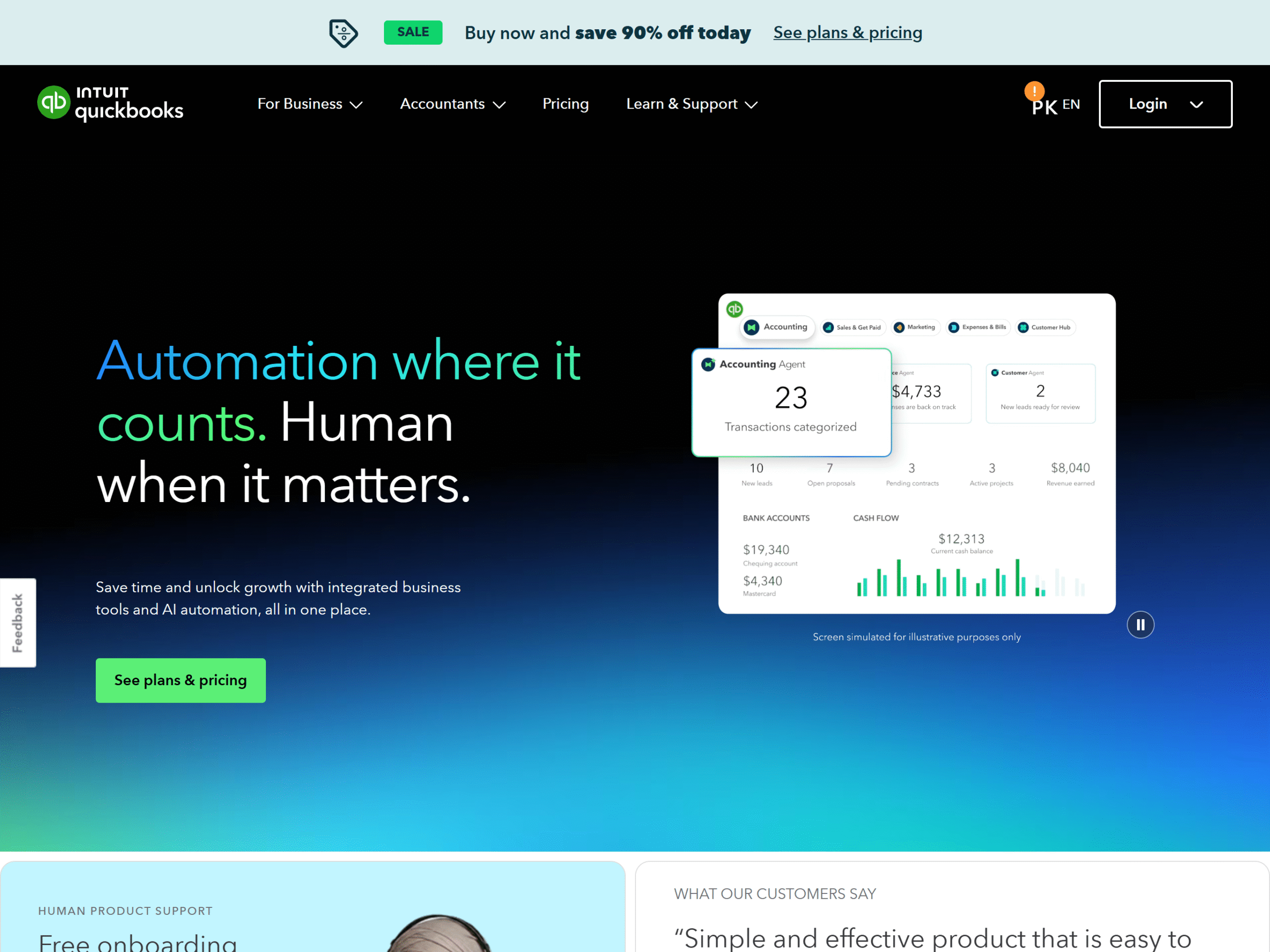
QuickBooks Online Advanced is considered the most widely used AI accounting software among growing companies and professional accountants. It is a combination of traditional cloud accounting with the help of automation and the insights from using AI, thus making it a practical example of the computer’s use in accounting rather than just an experimental tool.
For QuickBooks Online to be considered a very smart accounting AI, it employs machine learning, which analyzes the transactions’ patterns and suggests accurate categorization. Eventually, the system becomes more accustomed to the user’s way of doing things, and thus, the cooperation between accountants and AI becomes quite seamless. The finance team reaps the benefits of reduced manual effort and enhanced financial visibility through the use of automated workflows, batch invoicing, and predictive cash flow insights.
Plans and Free Features:
The permanent free plan is not available with the QuickBooks Online Advanced. Nevertheless, it extends a free trial offer to new users. Moreover, the advanced plans provide more benefits like AI-assisted automation, user permissions as per individual requirements, and improved analytics in comparison to lower tiers.
Pros:
Cons:
All in all, QuickBooks Online Advanced is at the forefront of the accounting AI technology adoption process by taking the mundane tasks away from the accountants while leaving the accountants in control.
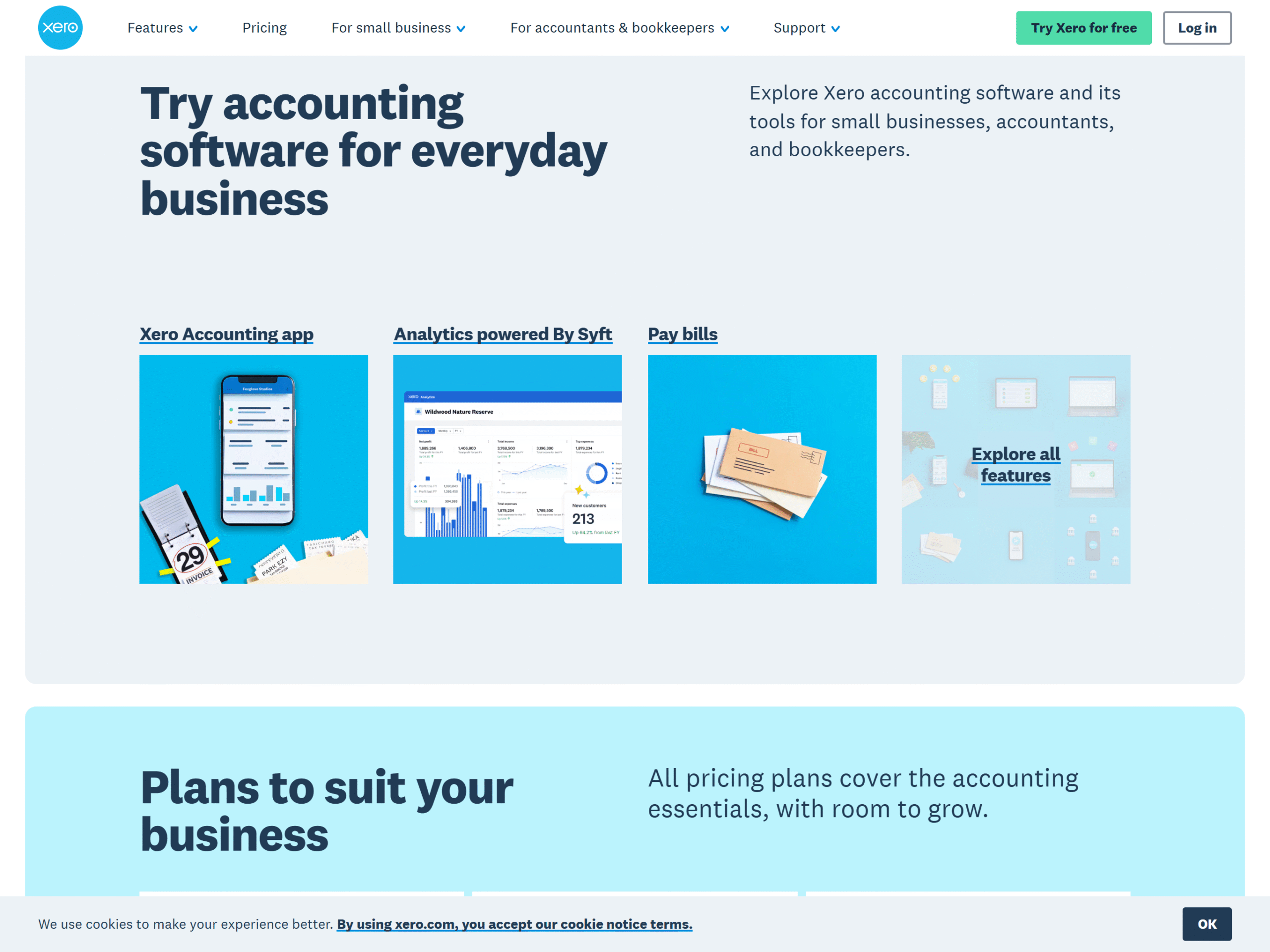
Xero is a cloud-based AI accounting software created for small to medium businesses, startups, and accounting firms. Apart from that, it allows the user to easily use it and slowly incorporate the AI features in accounting into daily bookkeeping and finance management.
The AI powers of Xero are shown in the features of the automated bank reconciliation, smart transaction combining, and invoice processing. These features show how AI in accounting can cut down on repetitive data entry and, at the same time, enhance accuracy. Xero constantly learns from past data, which makes it easier for both accountants and AI to work together in preserving the clarity and correctness of financial records.
Plans and Free Features:
Xero does not include a free plan but gives a free trial to new users. The AI features are upgraded with higher subscription plans, which provide better reporting and automation tools as well.
Pros:
Cons:
Xero is a clear example of how AI accounting software could make bookkeeping easier by not imposing the technology on the users, so it is very suitable for small businesses that are the first to adopt accounting AI.
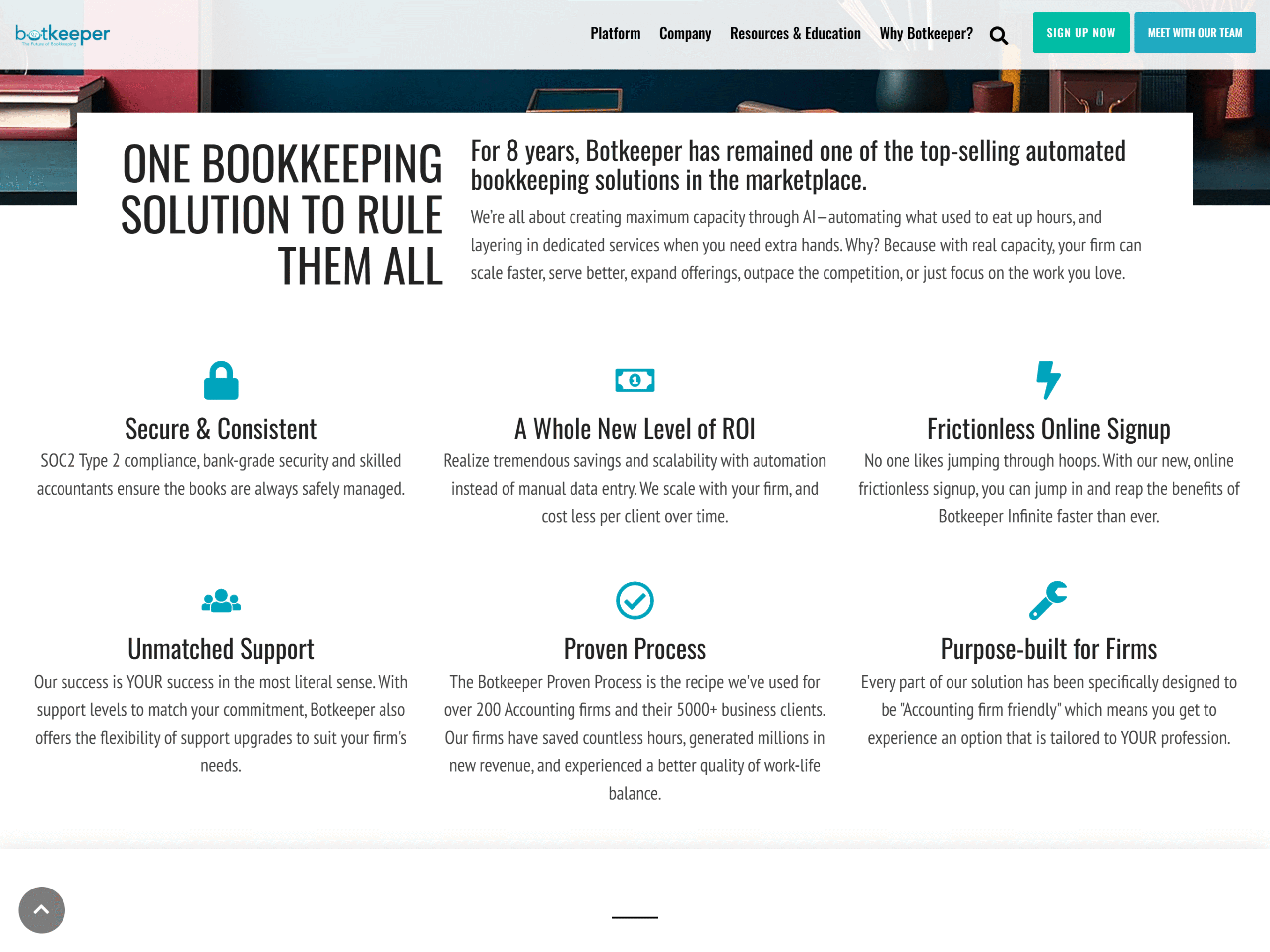
Botkeeper is an accounting AI platform that is specially designed and dedicated to fully automated bookkeeping. It is an entirely different approach compared to the conventional tools. It is the first and only accounting application to go through the entire process of traditional bookkeeping, and finally, it is the one with the automated solution.
The Botkeeper, with the help of machine learning algorithms, is, without human interference, to some extent, but for instance, it will process transactions, reconcile accounts, and generate financial reports all by itself. Thus, the collaboration between accountants and AI in the real-world context is highlighted, where the AI is responsible for handling the volume and speed, while the accountants are focusing on review and advisory services.
Plans and Free Features:
Botkeeper runs on a custom pricing model, which will be decided by the size of the business and the volume of transactions. Although there is no free plan, demos and onboarding support are provided.
Pros:
Cons:
Botkeeper is considered an ultimate AI accounting software solution that offers an unprecedented level of automation, thus making it particularly useful for the accounting staff who want to scale up the use of AI in the accounting process.
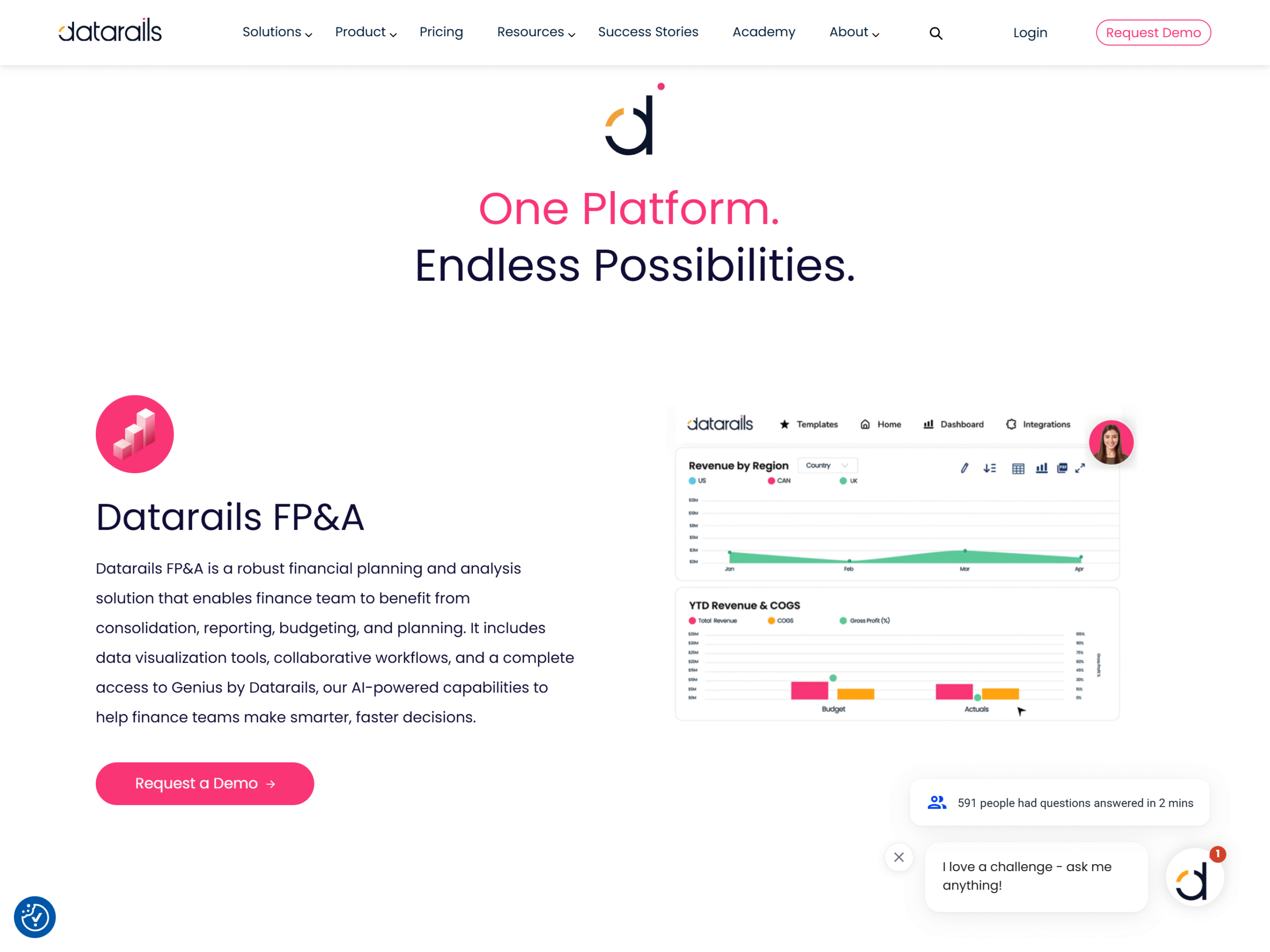
Datarails is an innovative AI accounting software that is mainly designed for financial planning, forecasting, and performance management rather than daily bookkeeping. It has gained a lot of popularity among financial departments that mainly depend on Excel, but at the same time want to integrate accounting AI into their processes.
The AI of Datarails helps to merge data from different systems, find errors, and produce financial forecasts in real-time. Consequently, accountants will be using AI in accounting even if their usual tools are spreadsheets. The application improves the communication between the accountant and AI by transforming unprocessed financial data into usable insights.
Plans and Free Features:
Datarails adheres to an enterprise pricing model and hence does not have a free tier. Nevertheless, organizations can ask for demos and pilot projects.
Pros:
Cons:
Datarails has shown the potential of accounting AI in financial planning by the incorporation of predictive analytics and automation in the decision-making process, thus allowing one to be more intelligent in his/her choices.
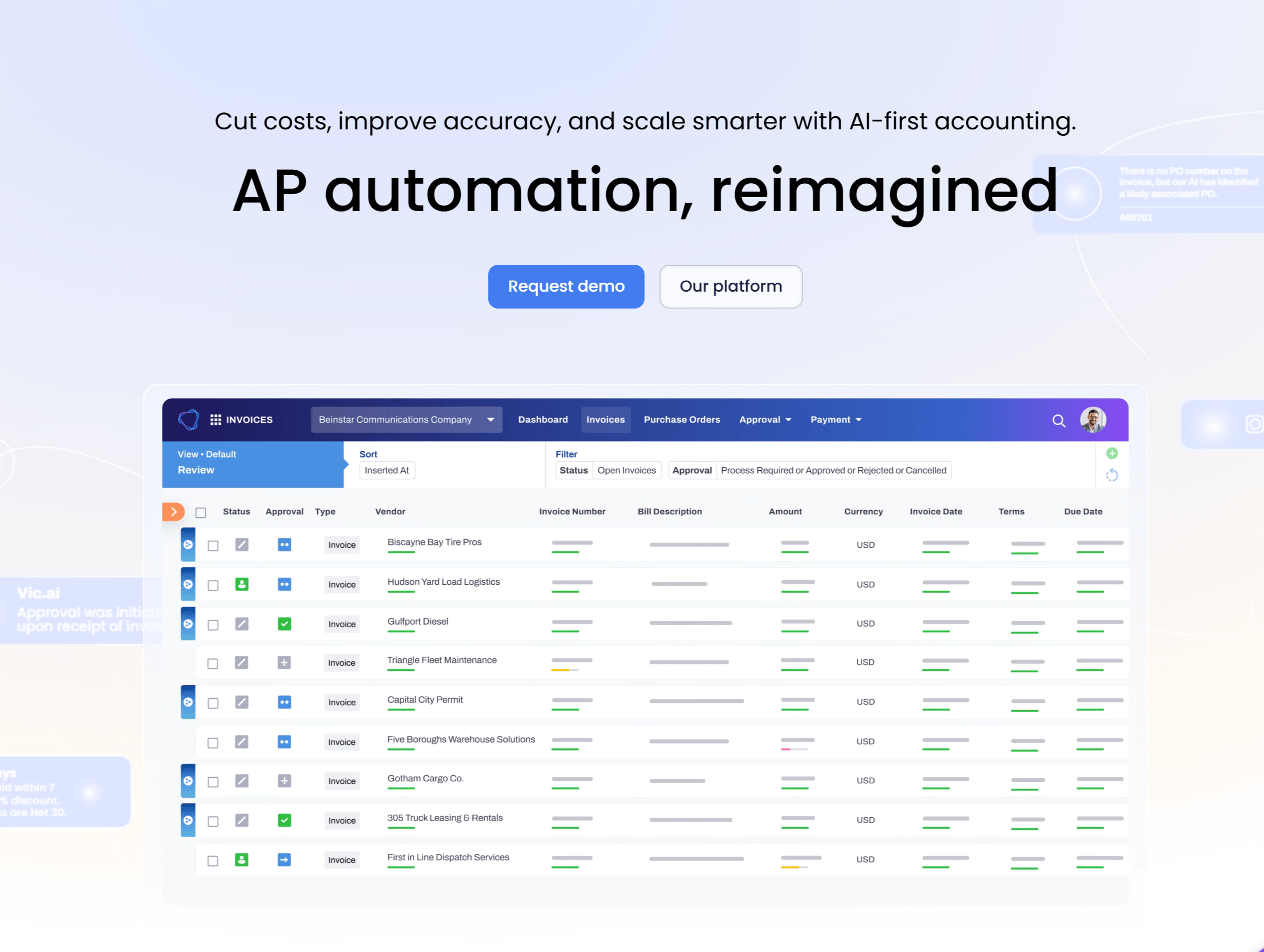
Vic.ai is an advanced AI accounting software that has been designed primarily for the automation of accounts payable, accounts receivable, and transaction analysis processes. The software applies a selection of deep learning techniques to recognize or classify transactions, capture financial outliers, and forecast outcomes with the least possible human intervention.
One of the features that gives Vic.ai the edge over the rest of the accounting AIs is the capability to learn faster with the least amount of historical data. This aspect of the software makes the man-machine partnership in the accounting processes more fruitful, especially in the case of high-volume accounting environments. Vic.ai notifies the accountants of the odd transactions at the time they happen, thereby helping them to spot the mistakes or criminal acts as soon as possible.
Plans and Free Features:
Vic.ai has a custom pricing model with no free tier. Demos are provided for businesses that would like to experience the company’s AI capabilities before making a decision.
Pros:
Cons:
Vic.ai is undoubtedly one of the best AI-enabled accounting software that not only automates the accounting but also provides intelligent analysis of financials, thus becoming one of the most powerful accounting AI tools currently available.
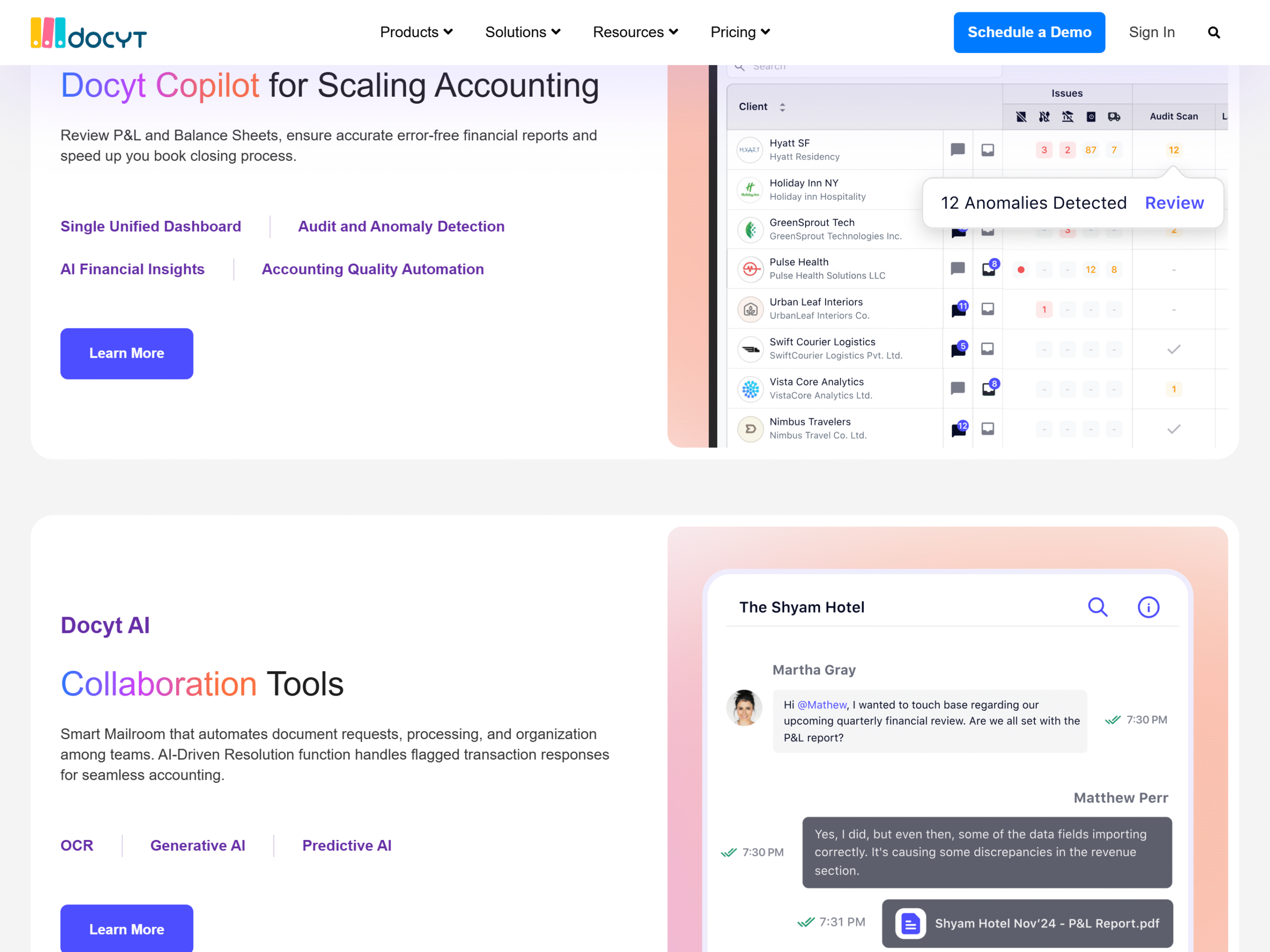
Docyt is a revolutionary ai technology based accounting software that is mainly purposed for small enterprises, new ventures, and accounting firms to completely automate their bookkeeping and financial documentation management. It serves as a smart financial guide through the collection, structuring, and deciphering of financial data instantaneously, thus being a very good example of the use of AI in accounting.
Docyt takes advantage of accounting AI to get data from the digital paper trail of invoices, receipts, bank statements, and bills. It employs machine learning to assign the expenses to the right categories and is trained continuously on this aspect. This sets a scenario where the accountants and the AI are working together like a well-oiled machine: AI is doing the documentation and categorizing while accountants are dealing with review, compliance, and financial advice.
The feature that distinguishes Docyt from others is the financial visibility that is available in real time. No more waiting for the month-end close, the accountants and the business owners can check the reports that are not older than a day at any time of the month. This is a clear illustration of how AI accounting software can lead to better and faster decision-making by providing timely insights instead of static reports.
Plans and Free Features:
Docyt has a subscription plan based on the size of the business. A free trial is available to customers that will enable them to test the AI-powered document processing and expense categorization before signing up.
Pros:
Cons:
Docyt is a powerful and affordable AI accounting software tool that illustrates the potential of AI to make accounting less of a burden while still having the accountants in control.
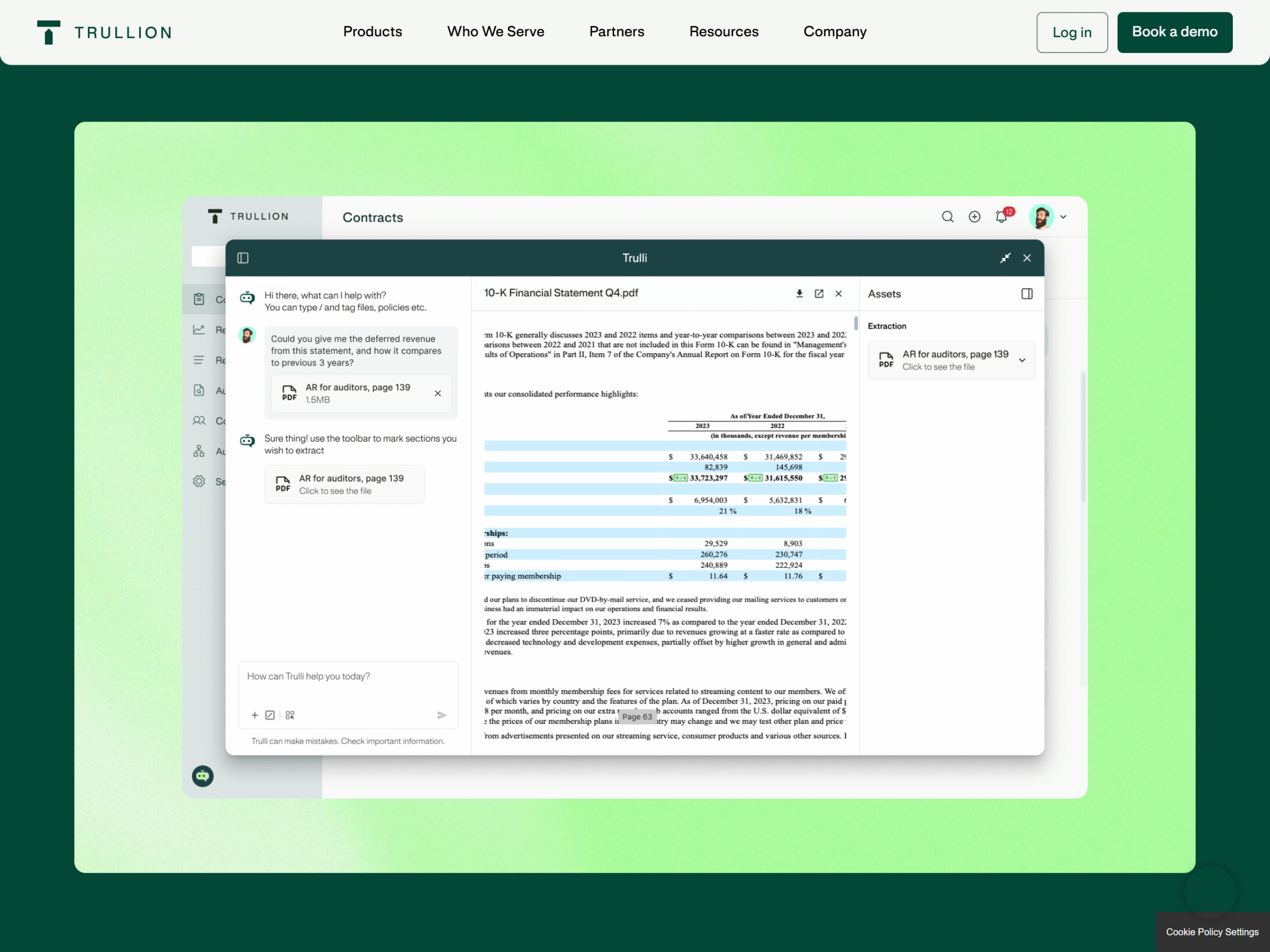
Trullion is an accounting AI platform that is specifically designed for the purpose of automating the whole accounting process for leases, revenue recognition, and financial compliance. The platform is, however, best suited for companies having to deal with a lot of contracts and the corresponding legal/regulatory requirements.
AI technology is the backbone of the Trullion software that uses data extraction and natural language processing to scan the financial documents to find the accounting data and convert it into structured entries. This whole process of manual review is considerably lessened, and hence, it is proven that AI in accounting can work on unstructured data so easily. Here, the collaboration of the accountants and the AI is very important because AI is the one that speeds up the document processing, and the accountants are there to check and explain the results.
Trullion can be said to be a powerful tool, especially in the case of financial statements that are compliant with accounting standards like ASC 606 and IFRS. By taking over the calculations and disclosures, it minimizes the risk of noncompliance and, at the same time, ensures precision. All these features turn it into a high-value AI accounting software solution for the audit environments with heavy traffic.
Plans and Free Features:
Trullion has a custom enterprise pricing model. There is no free plan available, but demos and pilot access are offered.
Pros:
Cons:
Trullion displays the ability of the accounting AI to handle heavy regulatory workloads, which, in turn, allows accountants to give more time to judgment rather than manual document analysis.
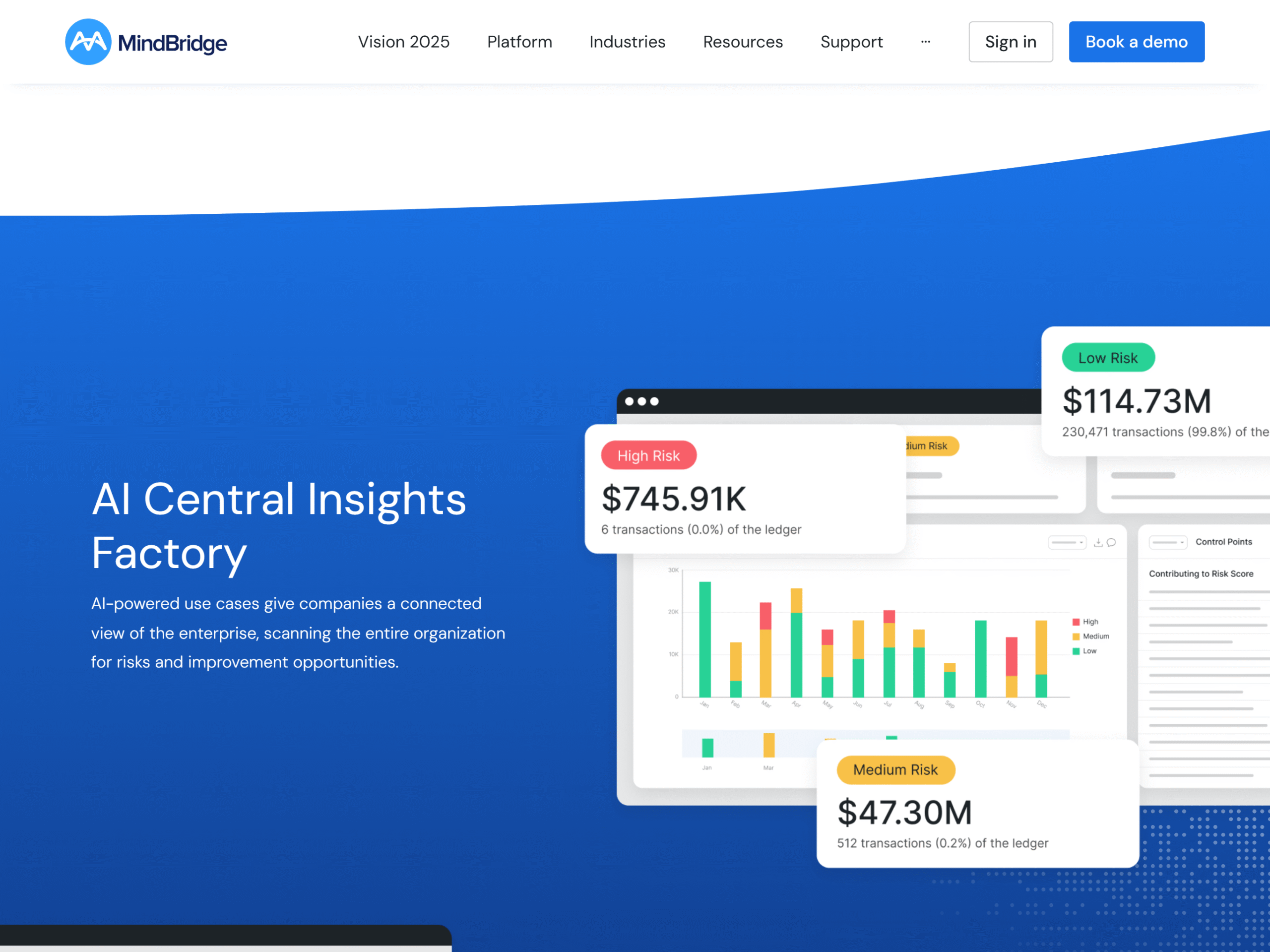
MindBridge AI is a notable AI accounting software that offers a range of capabilities for the audit, assurance, and risk management domains. Whereas conventional audit tools limit their examination to sampling methods, MindBridge guarantees an analysis that includes the whole data set by its operation, thus being a great representation of the cutting-edge AI technology in the accounting field.
Machine learning is the core technology behind MindBridge’s ability to detect anomalies, strange transactions, and risky behaviors scattered across the whole data set. The scenario of the method of carrying out audits has been drastically changed, and, in the process, the accountants and AI have developed a new way of working together, where AI does the heavy lifting with an in-depth data analysis, and the accountant gives the final approval based on professional judgment.
Risk scoring is one of the factors that greatly enhance the MindBridge experience. Each of the transactions is assigned a score according to the degree of risk, so the auditor or accountant can devote their time and efforts to the areas that are of the utmost importance. In case of audits, this means less time spent and better and more confident quality. As an AI tool for accounting, it delivers higher accuracy, improved transparency, and better conformity to rules and regulations.
Plans and Free Features:
MindBridge does not have a free plan but offers an enterprise-level price that is the highest level of service. Organizations may take the opportunity to schedule demonstrations or test drives of proof-of-concept.
Pros:
Cons:
MindBridge AI showcases the process by which audits are being transformed, with AI accounting software that is reactive checks-free and proactive, data-driven assurance-going.
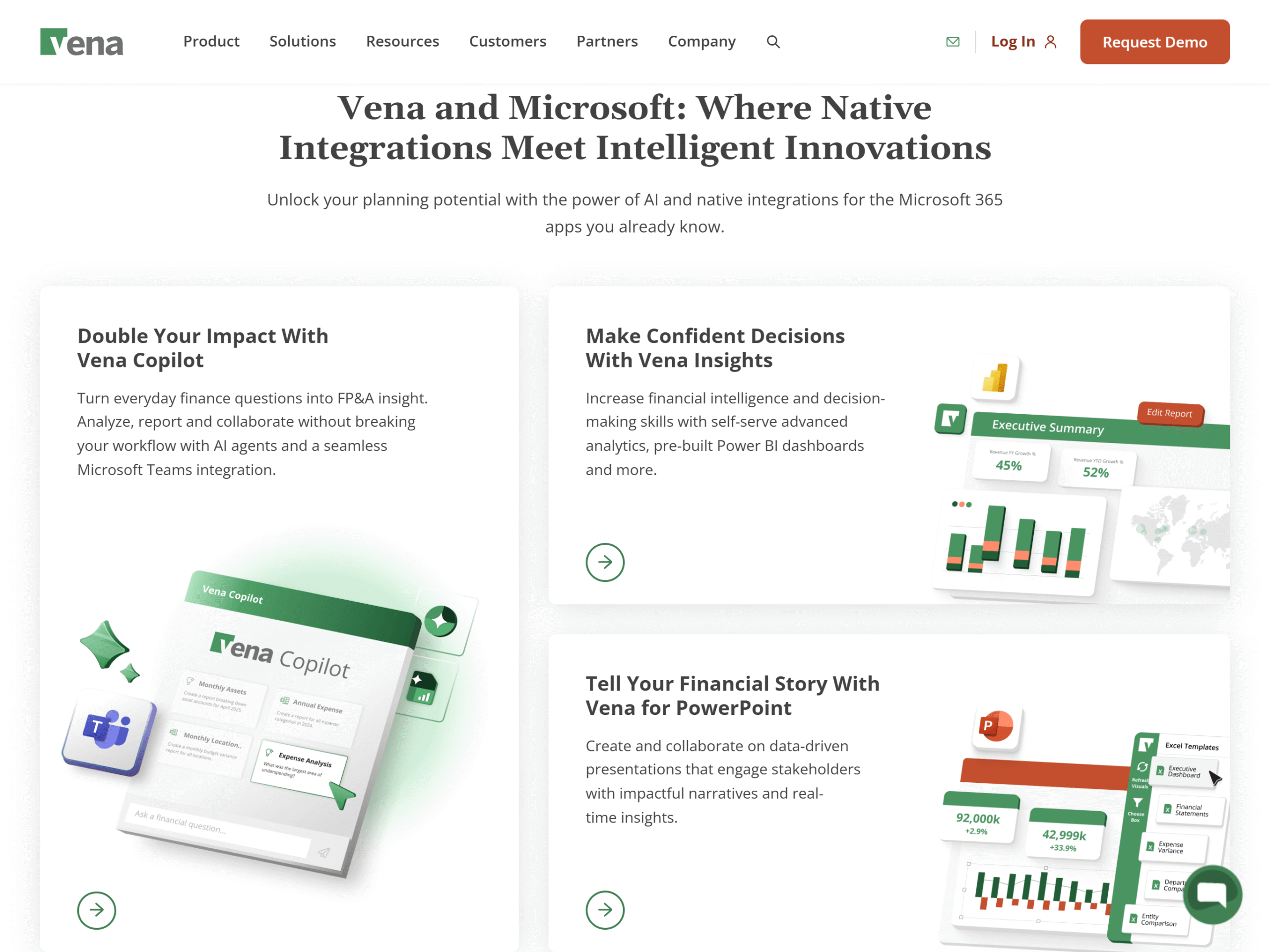
Vena Solutions is an artificial intelligence software platform that focuses on financial activities like planning, budgeting, and managing performance. The majority of finance departments that use the software do so to enhance their accounting AI with Excel.
Vena ties in with Excel, but also introduces AI-driven forecasting, scenario analysis, and data validation. This two-pronged tactic simplifies AI in accounting as finance workers are not required to leave the comfort of their tools. On the contrary, accountants and AI work together in a better-equipped spreadsheet setting.
The software utilizes AI to spot trends, find irregularities, and forecast with greater precision. Consequently, firms can shift from fixed budgeting to rolling planning. Thus, the use of AI in accounting by Vena leads to the support of smarter decision-making and the creation of a long-term financial strategy.
Plans and Free Features:
Vena functions on a large enterprise subscription and does not have a free plan. However, it does allow for demos.
Pros:
Cons:
Vena Solutions, through its AI accounting software, has shown that the financial planning process can be profoundly impacted and yet still be acceptable by the accountants’ way of working.
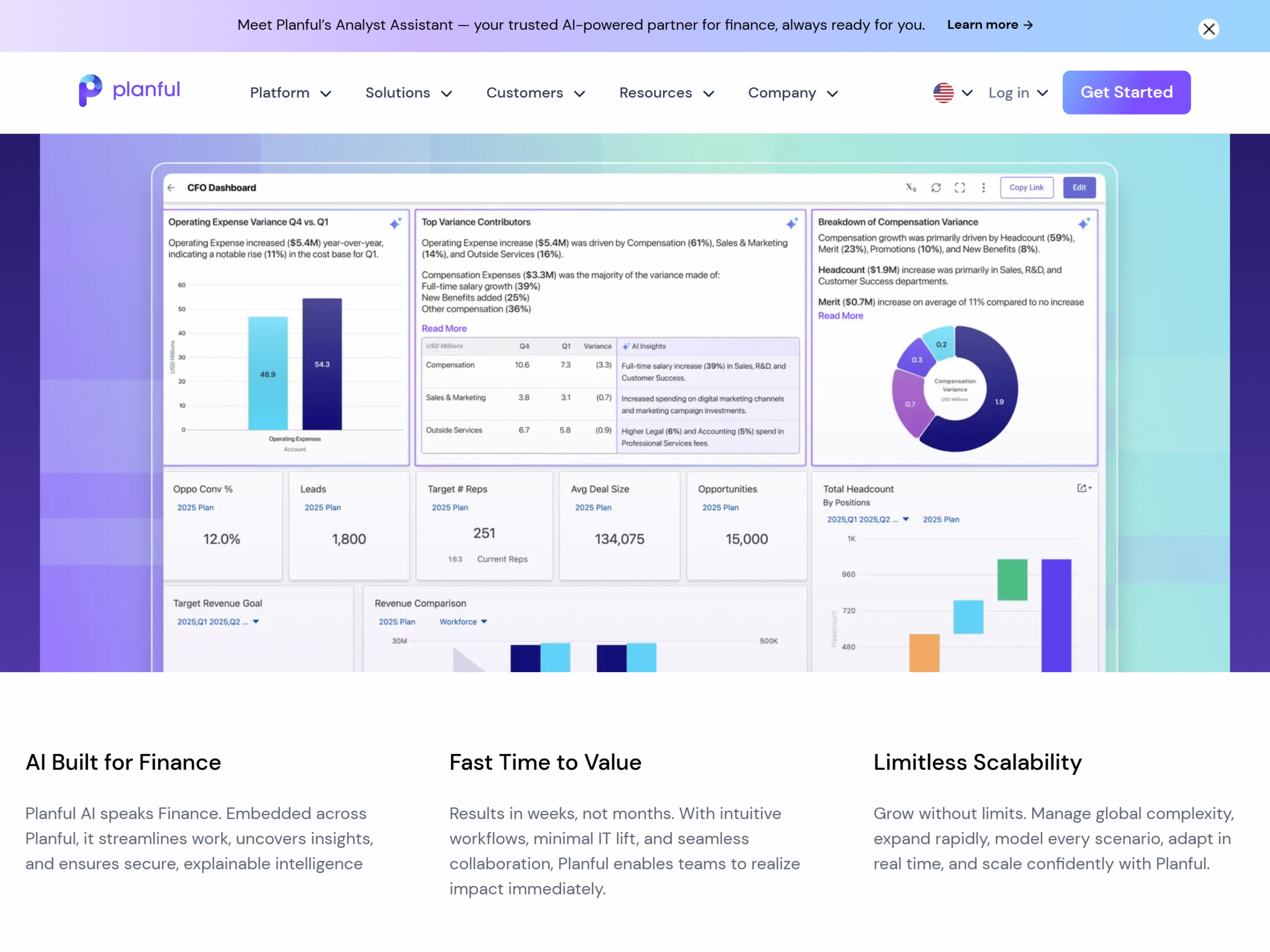
Planful is the leading AI-powered accounting software solution for continuous financial planning, forecasting, and performance analysis. It allows companies to transform their traditional, yearly budget into dynamic, AI-centered financial models.
Planful application of accounting AI for automating forecasting, scenario modeling, and variance analysis. It gives predictive insights by analyzing historical and current data, which in turn improves decision-making. This is a clear indication that AI in accounting is changing the financial sector from reporting past results to influencing future strategies.
Planful further allows the sharing of ideas, information, and resources among finance teams by introducing a platform where accountants and AI can interact directly and work on the same financial plans. The use of dashboards and KPIs ensures that performance is instantly visible, thereby making responding to market changes quite easy.
Plans and Free Features:
Planful has an enterprise pricing policy with no free plan; however, demos and guided hours are accessible.
Pros:
Cons:
Planful is an embodiment of how AI-integrated accounting software revives financial planning, ensuring that accountants become proactive financial leaders rather than just reporters of financial information.
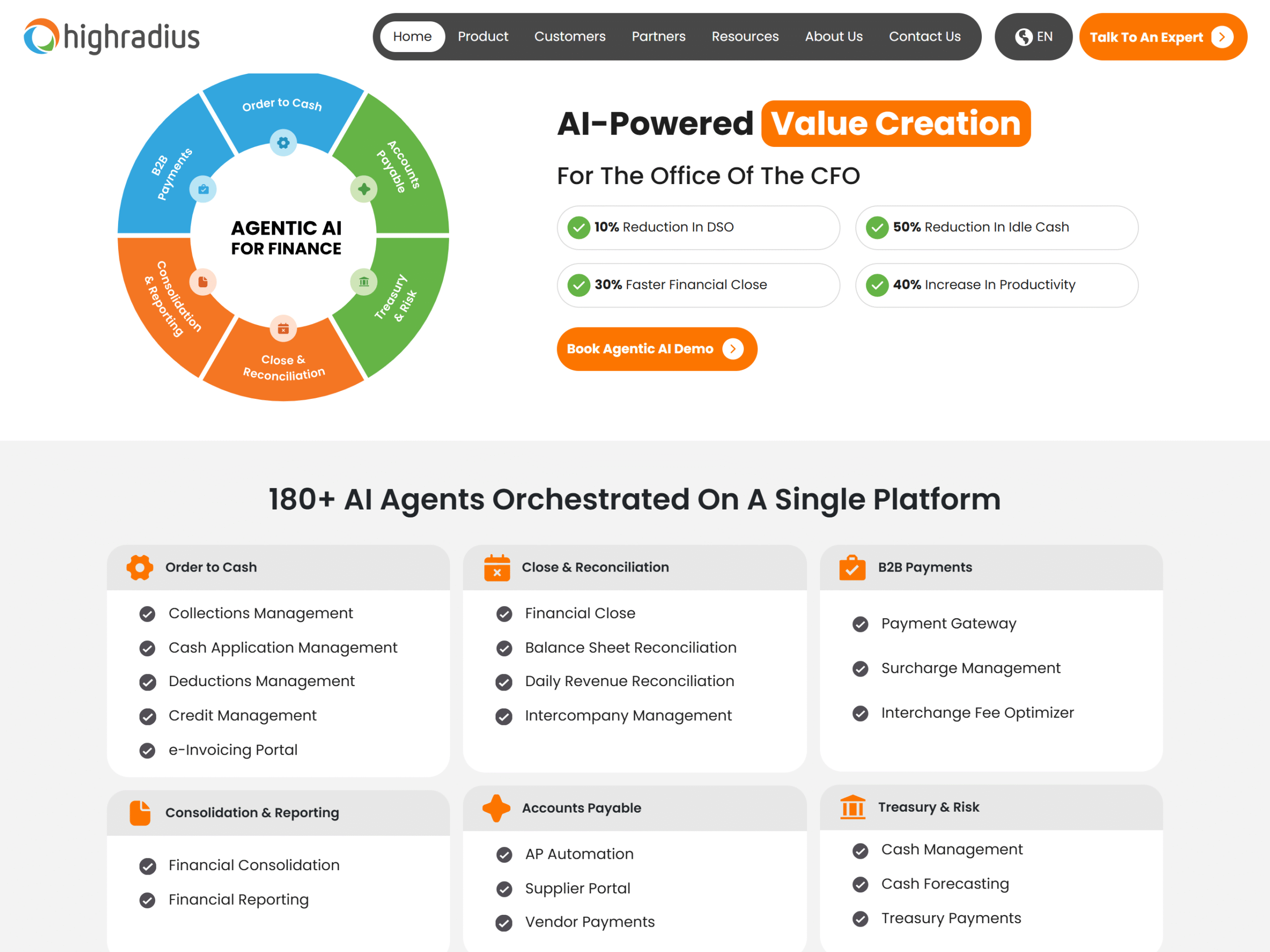
HighRadius is a state-of-the-art AI-powered accounting software that is meant for large-scale companies to automate and streamline processes like accounts receivable, credit management, and treasury. It is a go-to software for large finance departments that are looking to have a flow of cash, which is a result of accounting AI being used.
HighRadius makes use of machine learning to make cash applications, predict payments, and collections. The result is that the finance teams are no longer working reactively but rather making predictions and decisions. The platform is a great showcase of an AI application in accounting, particularly with respect to areas where manual follow-ups and tracking through spreadsheets were prevalent.
HighRadius’s major benefit is its ability to enhance the partnership between the accountant and the AI. AI categorizes customers according to their payment history and risk level, while the accountant’s resources are devoted to devising the best strategies for negotiation, conflict resolution, and financial planning. This leads to faster collections and better working capital.
Plans and Free Features:
HighRadius uses an enterprise pricing model with no free plan. However, demos and proof-of-concept evaluations are available to selected organizations.
Pros:
Cons:
HighRadius is a clear case illustrating how robbing AI accounting software could mean turning receivables into a strategic function and not a costly operational burden.
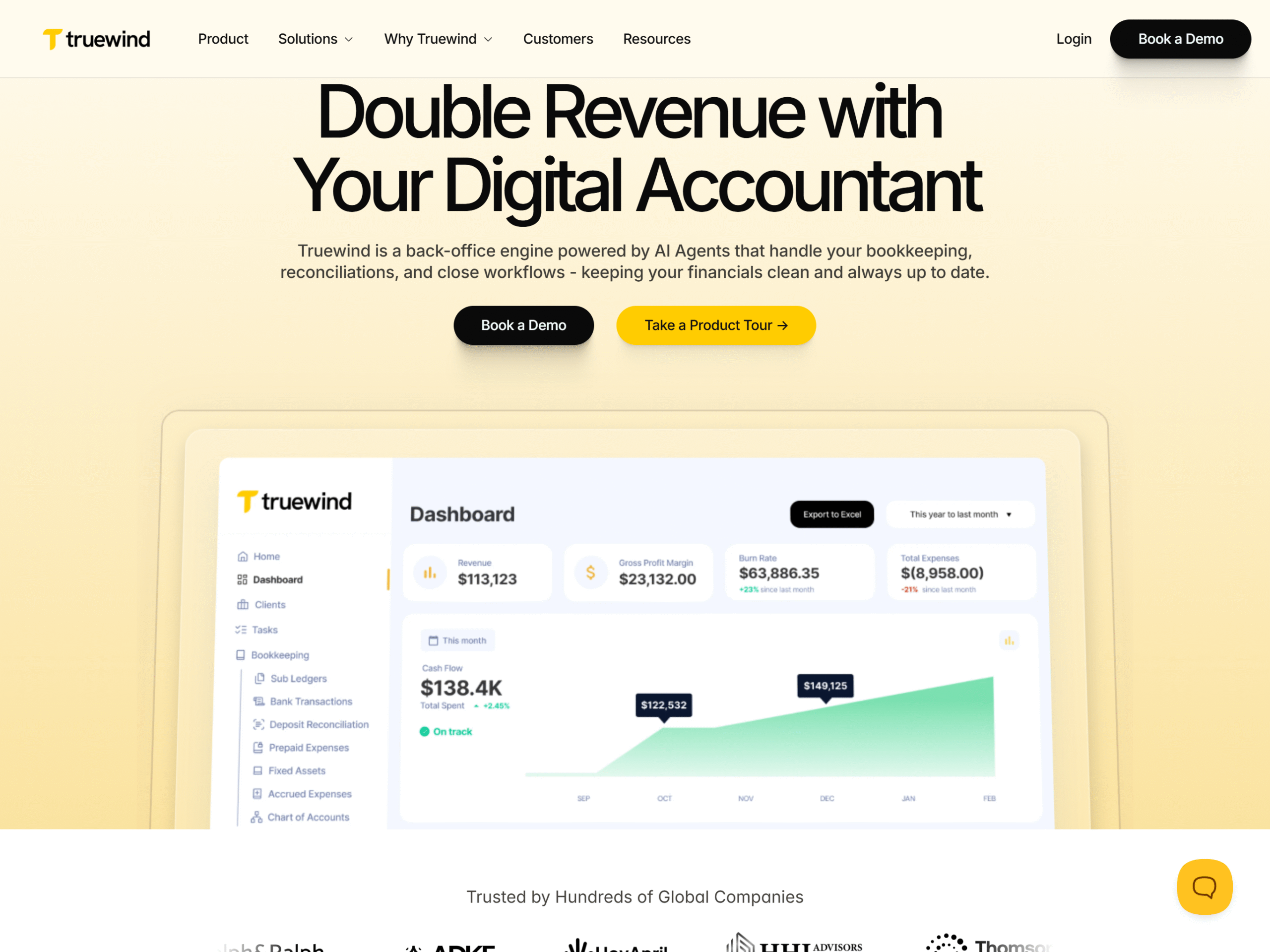
Truewind is an accounting AI software system, a modern platform that is built largely for audit automation, compliance, and financial assurance. It continuously audits and monitors, using AI in accounting to increase qualitatively and quantitatively the organization’s transparency and risk reduction.
Through AI, Truewind can instantly analyze whole ledgers of financial transactions, produce audit trails, and report suspicious events in real time. The question of reliance on periodic audits is circumvented in this case through a provision of ongoing assurance. This approach revamps the traditional audit model and, at the same time, underscores the changing nature of the accountants’ and AIs’ collaboration.
The service is indispensable in highly regulated sectors, where compliance and precision are outright necessities. It practically eliminates the financial data testing process, yet the trust in the data remains as high as before. With the software lifting up the routine checks, the accountants are free to devote their time and energy to making judgmental assessments and interpreting regulations.
Plans and Free Features:
Truewind gives custom pricing for the enterprise. There’s no free plan, but there will be demos and guided onboarding sessions available.
Pros:
Cons:
Truewind presents an argument of how AI accounting can impact the financial environment positively and make it more transparent by bringing audit and compliance AI directly into the accounting area.
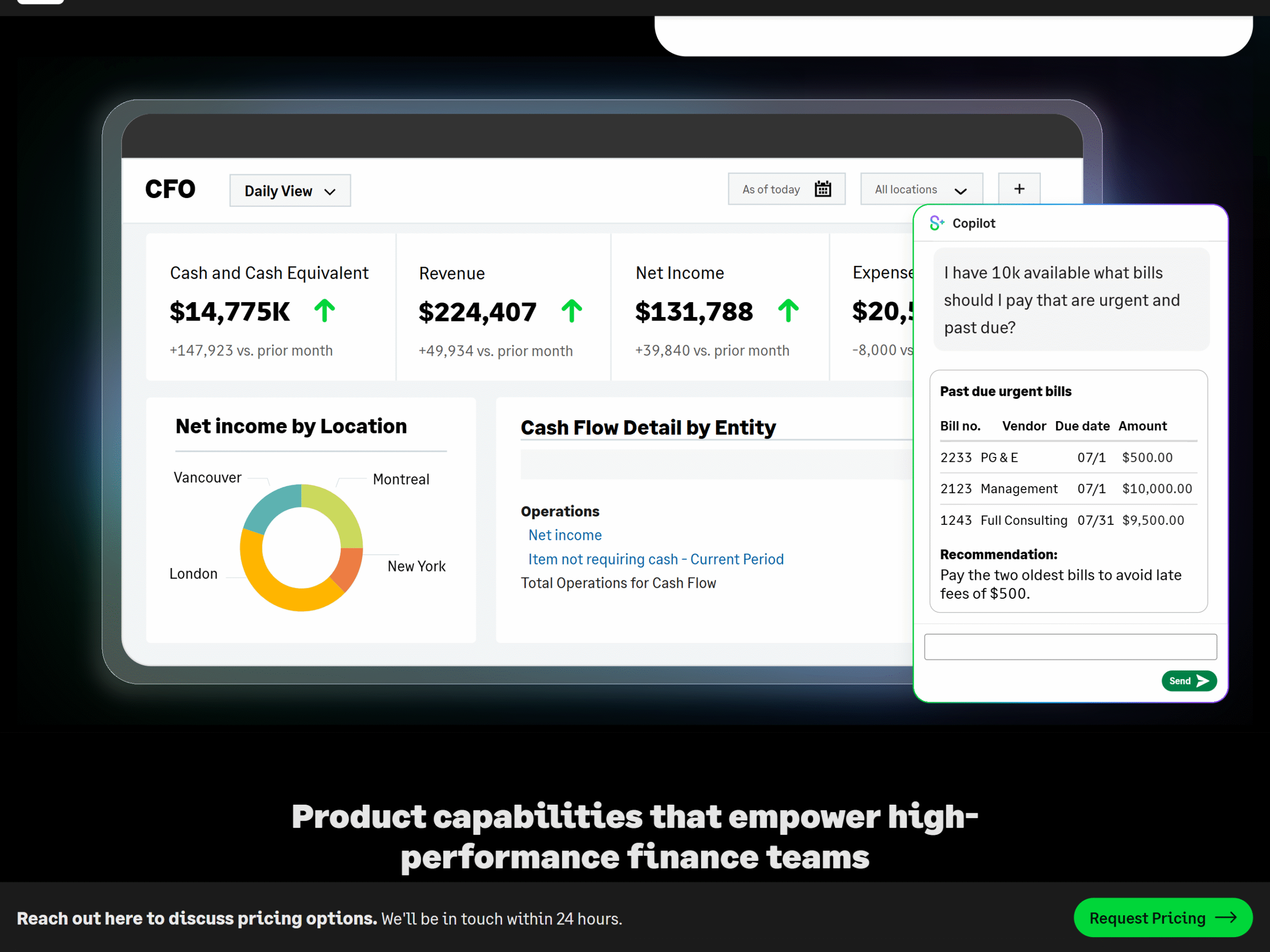
Sage Intacct, the AI accounting software platform, is a thoroughgoing cloud-based platform that is very AI, and it is perfectly suitable for mid-sized and growing businesses. This solution has become widely trusted in the adoption of AI in the accounting area because it integrates core financial management with automation and AI reporting.
The developers behind the multi-purpose Sage Intacct have incorporated accounting AI to automatically post to the general ledger, accounts payable, accounts receivable, and financial consolidation. Its AI-powered dashboards give users a real-time view of the financial position, which leads to quicker and better decision-making. The combination of accountancy and AI creates a very efficient partnership where automation is a strong supporting player, helping both in terms of accuracy and speed.
One of the main platform’s areas of strength is the ability to handle simultaneously different entities and currencies, which is really a prerequisite for very complex firms. Although Sage Intacct’s machine learning capabilities are more assistive than deeply predictive, they do large parts of the manual workload and eliminate reporting delays to a great extent.
Plans and Free Features:
Sage Intacct has no free plan; it follows a subscription-based pricing structure. The interested customers can have hands-on experience and consultations regarding the product through demos and trial consultations.
Pros:
Cons:
Sage Intacct is a dependable benchmark for the AI accounting software turnaround that enriches traditional accounting systems with intelligent automation.
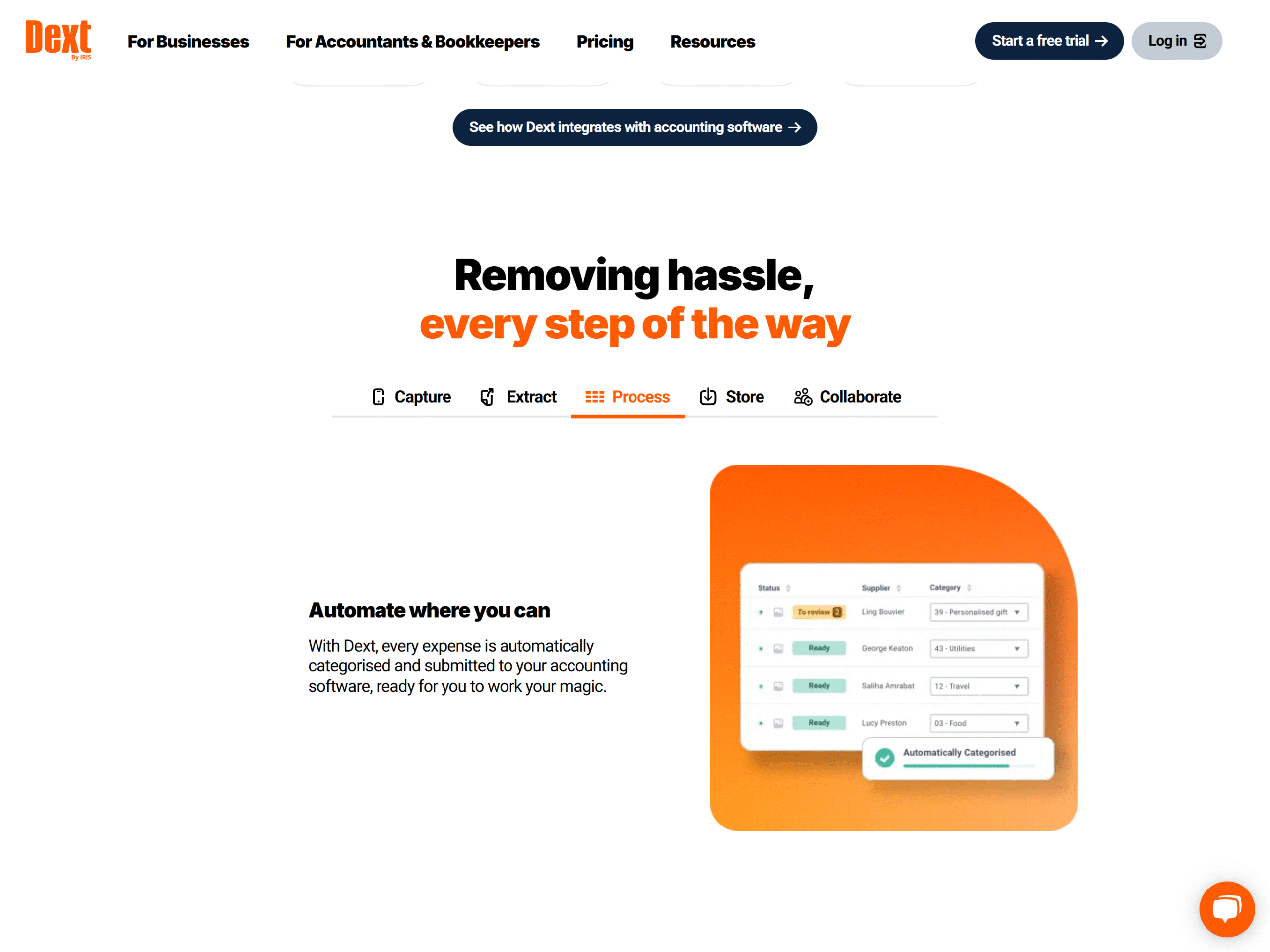
Dext Prepare, which was previously called Receipt Bank, is a highly specialized AI-powered accounting tool dedicated to the automation of receipt, invoice, and bill data capture. This tool is a significant contributor to minimizing manual data entry, which is one of the most tiring and time-consuming tasks in accountants’ daily work.
By means of Optical Character Recognition and machine learning, Dext Prepare pulls out the mandatory data from the receipts and invoices, then posts them directly in the accounting systems. This is the point at which AI has come to play in accounting by facilitating document-heavy workflows. To accountants and AI, Dext functions as a virtual assistant that tirelessly takes care of the raw data while the accountants are in the process of reviewing and approving the entries.
Dext is very well-integrated with the leading AI accounting software like Xero, QuickBooks, and Sage, to name a few, thus making it a valuable extension rather than a replacement of these software programs. It is particularly beneficial for small businesses and accounting firms that are processing a high number of receipts.
Plans and Free Features:
The pricing model for Dext Prepare is that of subscription-based plans, along with a free trial for new users.
Pros:
Cons:
Dext Prepare is the best example of how accounting AI is able to cut down the most repetitive tasks and, at the same time, improve the quality of the data.
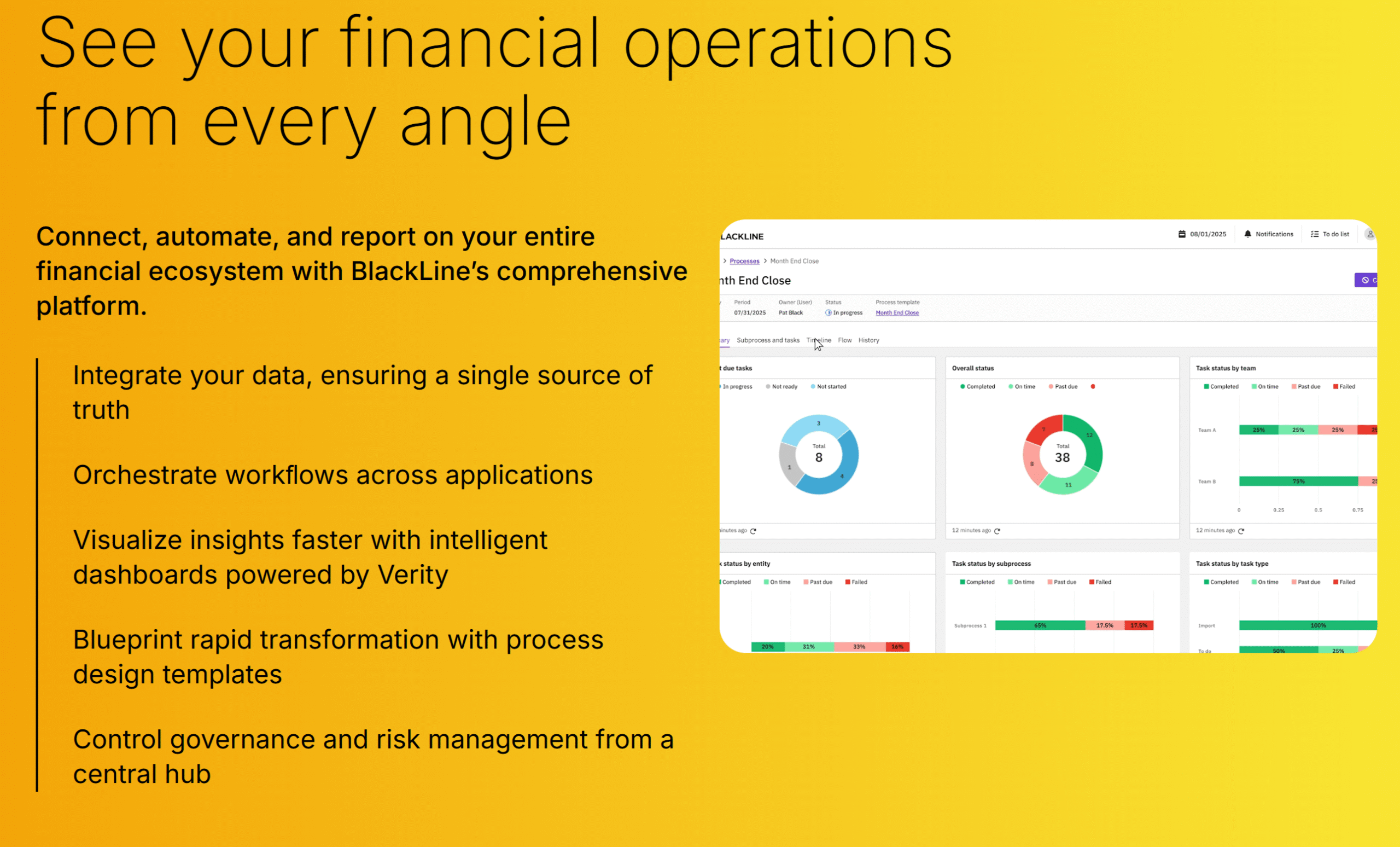
BlackLine is an enterprise-grade software for AI accounting that emphasizes the automation of financial close, account reconciliation, and journal entries. It is preferred by most of the big organizations that need precision and control in complex accounting infrastructures.
With BlackLine, accounting AI takes a step further to automate reconciliation, identify mismatches, and ensure financial periods are consistently closed. This move leads to a substantial cut in the time taken to close the deal and makes the entire process more ready for an audit. The interaction between accountants and AI is quite important in this scenario, as AI is dealing with matching transactions while accountants are the ones to deal with exceptions and give approvals.
Moreover, the platform allows for continuous accounting, thus getting rid of the month-end rushes and always having reconciled accounts. This represents a very notable transition in AI in accounting, as now the whole process is automated, and thus the firm has precise financials at all times instead of waiting for the end of the month to get the report.
Plans and Free Features:
BlackLine operates on an enterprise model that does not include a free tier, hence no free trial. Demos are provided, and customized implementations are available.
Pros:
Cons:
BlackLine is a prime example of how AI accounting software can manage the large finance team by making the financial close a controlled, automated, and predictable process.
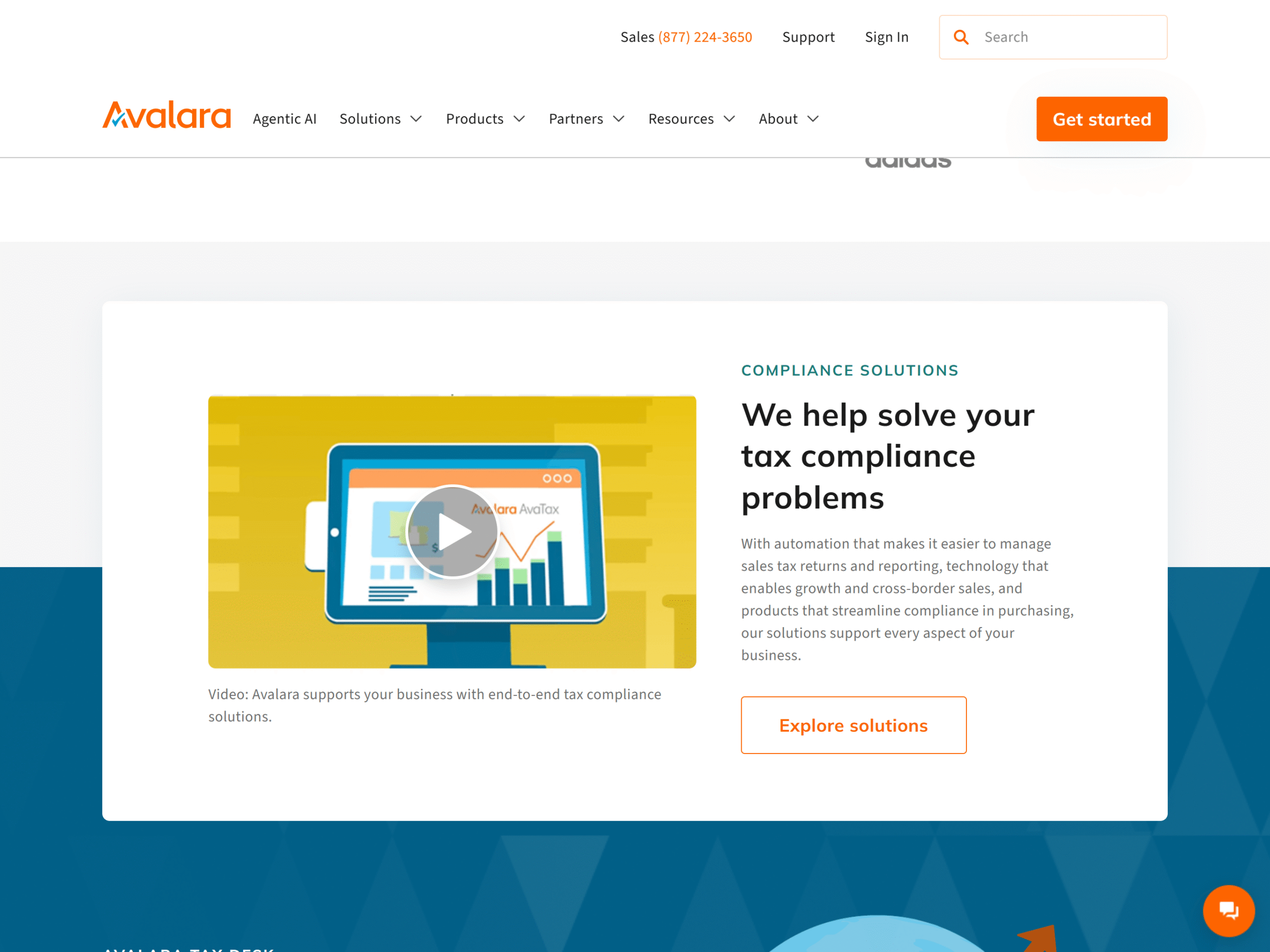
Avalara is an AI accounting software that is specially designed for tax compliance, tax calculation, and tax reporting. It is extensively utilized by companies that have a global presence and need to deal with complex sales tax, VAT, and GST requirements. Avalara is a good example of an AI accounting that helps to simplify one of the most error-ridden areas of finance, taxation.
Through accounting AI, Avalara can automatically tax real-time prices depending on the regulations that are constantly changing. To make sure the tax treatment is accurate, the system looks at the data of the transaction, location rules, and product classifications. This technique not only mitigates the risk of non-compliance and the necessity of manual research but also allows for the collaboration of accountants and AI in an efficient way. Accountants carry out reviews and devise strategies, while AI calculates and logs updates.
Among the many features of Avalara, its capability to stay current with tax regulations changes without manual intervention ranks as one of the most significant. This is a vital aspect for tax jurisdictions where tax laws are in flux very often. As an accounting AI software, Avalara is compatible with most accounting, ERP, and e-commerce platforms, thus facilitating tax automation of the whole process.
Plans and Free Features:
Avalara employs a module-based pricing model in which businesses pay only for the tax features that they need. Even though there is no permanent free plan, trial versions and limited demos might be accessible based on the area.
Pros:
Cons:
Avalara makes it evident that AI in accounting improves tax accuracy and compliance, besides reducing the administrative burden.
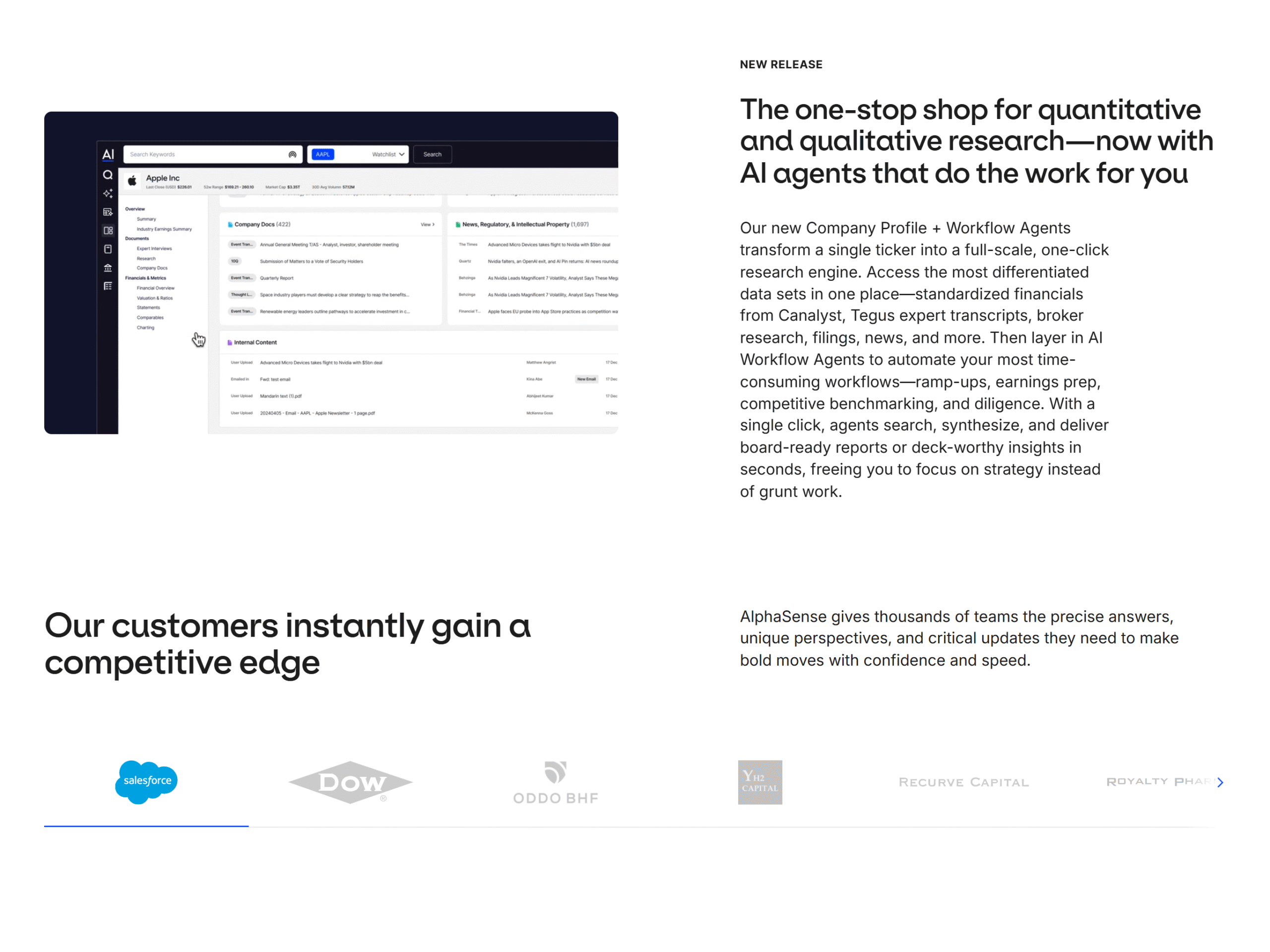
AlphaSense is a platform that leverages AI to provide financial intelligence and perform market research. It is not exactly a bookkeeping system, but it deeply impacts strategic finance and analysis by supporting decision-making through AI in financial and accounting research.
AlphaSense is able to search through large amounts of data, such as financial documents, earnings calls, filings, and research reports, using natural language processing and machine learning. As a result, finance and accounting professionals can extract insights from a significant amount of unstructured data in no time. In this collaboration between accountants and AI, the emphasis is placed on the analysis of data, rather than the processing of transactions.
As an accounting AI tool, AlphaSense comes in handy for CFOs, financial analysts, and advisory accountants who need to keep abreast of market trends, risks, and competitor performance. Furthermore, it not only eliminates the labor-intensive manual research but also augments the quality of financial insights.
Plans and Free Features:
There are no free plans offered by AlphaSense, but enterprise-level subscriptions are available. Demos and trial access can be arranged if requested.
Pros:
Cons:
Through its usage of AI accounting software, AlphaSense exemplifies that the performative aspect of bookkeeping goes far beyond that and includes strategic analysis and advisory services.
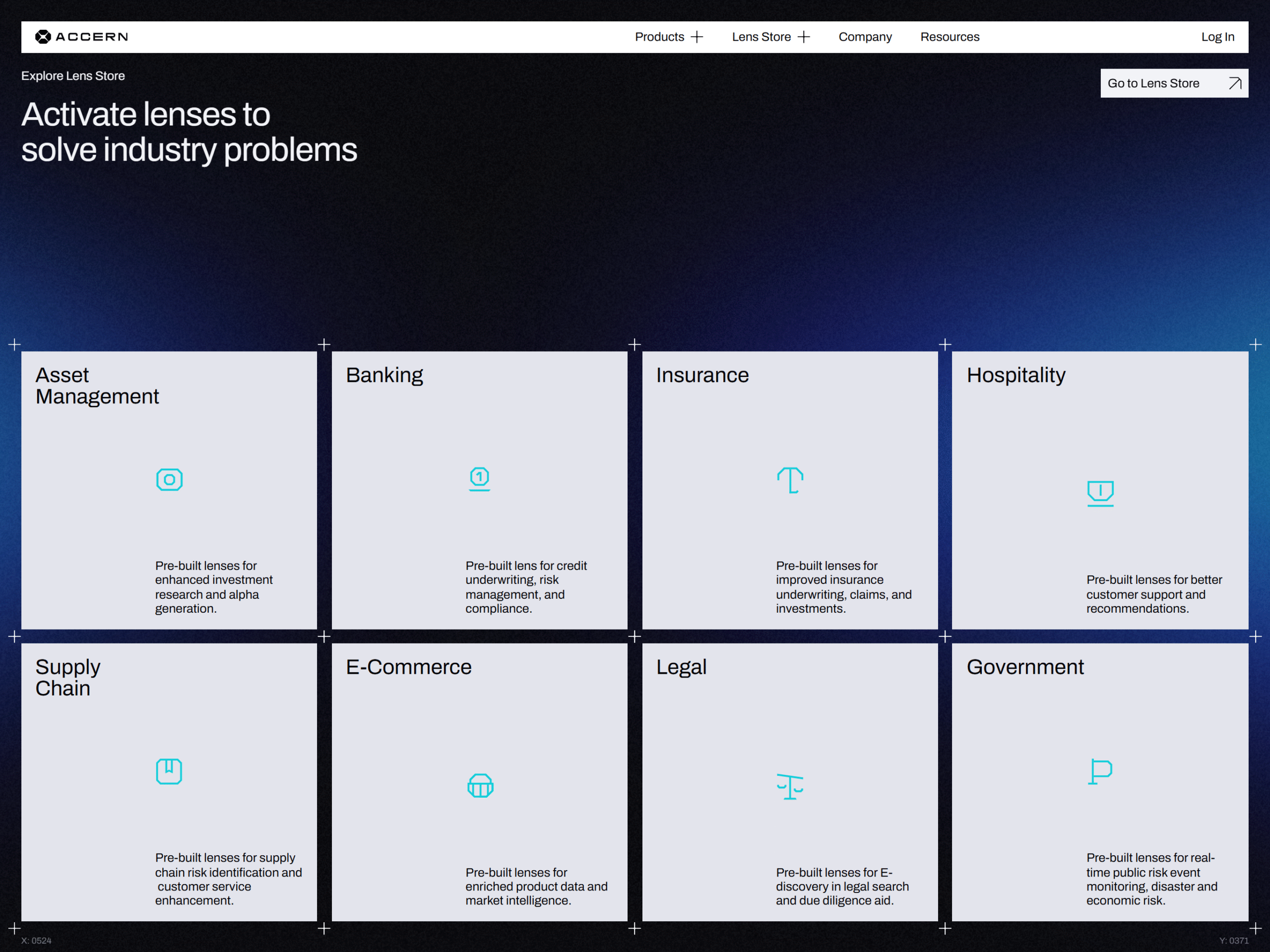
Accern is an AI-based platform that does not require any coding skills and is primarily meant for the accounting sector. It works with real-time financial data monitoring, alerts, and risk intelligence. The tool lets companies monitor and stay up-to-date with the financial events, news, and data that may influence their financial performance.
Accern incorporates AI into its operations to dissect enormous structured and unstructured data from worldwide sources. Sentiment analysis, entity recognition, and risk scoring are all employed to pinpoint the events with the greatest relevance. This scenario is a great illustration of the application of AI in accounting, specifically concerning risk management and monitoring of external finances.
The system permits the coexistence of accountants and AI by carrying out the monitoring of data automatically while the accountants are interpreting the insights and evaluating the financial impact. Accern is a necessary tool for compliance teams, investment companies, and finance departments requiring early alerts about financial or regulatory risk.
Plans and Free Features:
Accern follows a subscription pricing strategy and has no free tier. But then again, it does offer demos and trial access.
Pros:
Cons:
The role of Accern in the accounting sector is crystal clear: risk management and financial decision-making are not only informed but also made quicker by the use of AI.
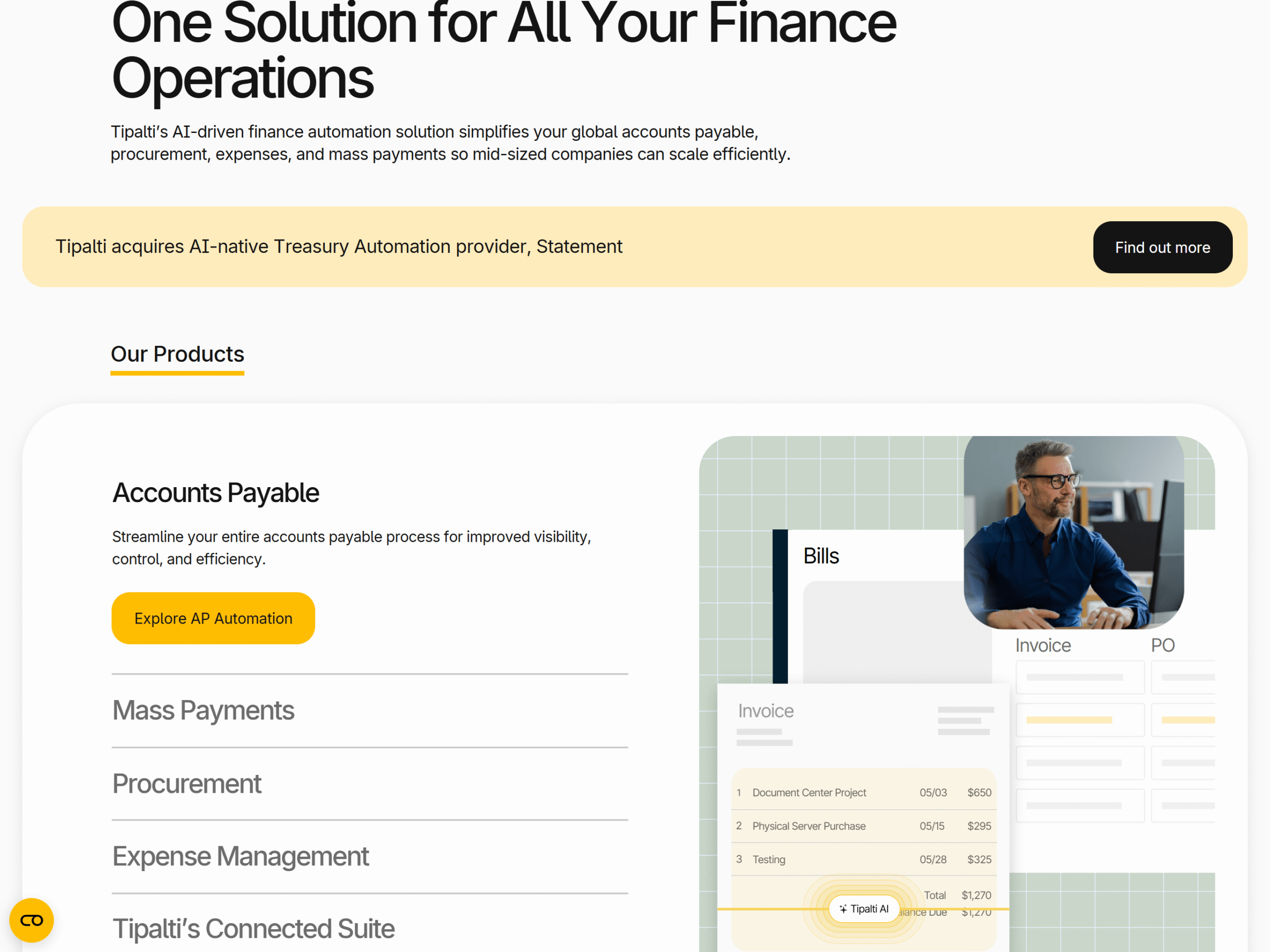
Tipalti is a total AI bookkeeping application that deals with the automation of accounts payable, and also of making global payments. It is a solution for organizations with a lot of payments to vendors and strict regulations to comply with.
The first step in the process is the use of accounting AI by Tipalti to automate invoice capturing, supplier data validation, and the payment workflow. AI-powered rules are used to draw accurate approvals, ensure compliance with tax regulations, and prevent fraud. This makes it possible for accountants and AI to work together in a very efficient manner, where AI is doing the operational tasks, and as a result, accountants are overseeing controls and strategy.
Tipalti’s global payment capability is one of the main reasons for its success. It can process payments through different methods and currencies at the same time and still be compliant with the regulations. Introducing Tipalti as one of the ai in accounting solutions will correspond to fewer payment errors, delays, and manual reconciliation.
Plans and Free Features:
The pricing model of Tipalti is a tiered one with no free plan. However, it offers demos and uses customized pricing.
Pros:
Cons:
Tipalti has proven that the use of AI in accounting software can completely transform the accounts payable department, making it quicker, more accurate, and compliant.
Tool | Core Use | AI Strength | Best For | Free/Trial |
QuickBooks Online Advanced | Full Accounting | Smart categorization | Mid-size biz | Trial |
Xero | Cloud Accounting | Bank feeds/AI match | Small/Mid | Trial |
Botkeeper | Bookkeeping | Automated classification | Firms | No |
Datarails | FP&A | Forecasting | Finance teams | Demo |
Vic.ai | AP/AR automation | Anomaly detection | AP teams | No |
Docyt | Bookkeeping | Doc capture | Small biz | Trial |
Trullion | Document analysis | OCR & NLP | Audit/Contracts | Demo |
MindBridge AI | Audit analytics | Risk detection | Audit firms | No |
Vena Solutions | FP&A | Budgeting/Forecasts | Finance teams | Demo |
Planful | Planning | Continuous planning | Enterprise | No |
HighRadius | Receivables | Cash App/Collections | AR teams | No |
Truewind | Audit automation | Compliance | Enterprise | Demo |
Sage Intacct | Financial mgmt | Reporting | Growing orgs | No |
Dext Prepare | Receipt capture | Smart extraction | Small biz | Trial |
BlackLine | Close & Reconciliations | Continuous reconcile | Large firms | No |
Avalara | Tax automation | Regulatory AI | Multi-region | No |
AlphaSense | Market intelligence | NLP search | Analysts | Demo |
Accern | Alerts & insights | Real-time alerts | Risk teams | Trial |
Tipalti | AP automation | Invoice AI | AP teams | No |
What AI tools are accountants using?
Accountants get to reap the benefits of AI technology through the use of AI accounting software like QuickBooks, Xero, Botkeeper, Vic.ai, and Sage Intacct. The these ai tools for accounting and finance allow the partnership of accountants and AI working together very quickly to efficiently accomplish the tasks of bookkeeping, reconciliation, and sharing of reports.
Which AI is best for finance and accounting?
The top accounting AI varies according to requirements: QuickBooks and Xero are ideal for small businesses, Botkeeper and Vic.ai are suited for firms, and Sage Intacct is for big businesses. AI utilization in accountancy becomes most effective when it corresponds with the organization’s size and complexity.
Is there a free AI for accounting?
Completely free AI accounting software is a no-show, but there are a few options like QuickBooks, Xero, and Dext that offer free trials or limited features. Thus, one can try out AI in accounting before actually going for a paid plan upgrade through these options.
Which AI is best for finance?
When it comes to finance and analysis, tools like Datarails, Planful, AlphaSense, and Vena Solutions are popular among users. These platforms reveal how accounting AI is involved in forecasting, budgeting, and strategic decisions.
Can AI analyse my bank statement?
The answer is yes, AI accounting software such as QuickBooks, Xero, and Vic.ai can perform automatic analysis of bank statements. This situation sheds light on the fact that accountants and AI are working in partnership to achieve better accuracy and efficiency in terms of time consumed.
The use of AI accounting software is a game-changer for the finance and accounting sectors. Routine bookkeeping, for instance, is completely automated, while the capabilities to provide accurate financial forecasting are amongst the properties and benefits that accounting AI has unlocked for organizations, besides time saving, error reduction, and enhanced financial decision making. QuickBooks Online Advanced, Xero, Botkeeper, and Vic.ai are some of the tools that illustrate the perfect partnership between accountants and AI; AI takes care of the monotonous tasks, and professionals dedicate themselves to strategy, compliance, and advisory roles.
The use of AI accounting technology is changing the workflows for all accounting activities—bookkeeping, audit, accounts payable, tax compliance, and financial planning. New-generation platforms such as Datarails, Vena Solutions, Avalara, and Tipalti prove that AI is a must-have for every business, regardless of its size. Even smaller companies can use AI by taking advantage of free trials or limited-feature tools like Docyt and Dext Prepare, thus attaining efficiency without incurring a major cost.
In summary, the use of AI in accounting is not only about getting rid of staff but, rather, it is about gradually unlocking Smarter Insights, getting better, and more empowered finance professionals who are allowed to concentrate on the value-added activities. Whether you are a CFO, an accountant, or a business owner, the implementation of accounting AI brings about a competitive edge, enhances compliance, and gives access to real-time financial intelligence, thus making a great leap towards the future of finance.